
LIVING WITH SOMEONE WITH OCD: WHAT HELPS, WHAT FEEDS IT
LIVING WITH SOMEONE WITH OCD: WHAT HELPS, WHAT FEEDS IT
Of all the ways families try to help a loved one with a mental illness, OCD produces the strangest trap: the more lovingly you help, the stronger the illness can grow.
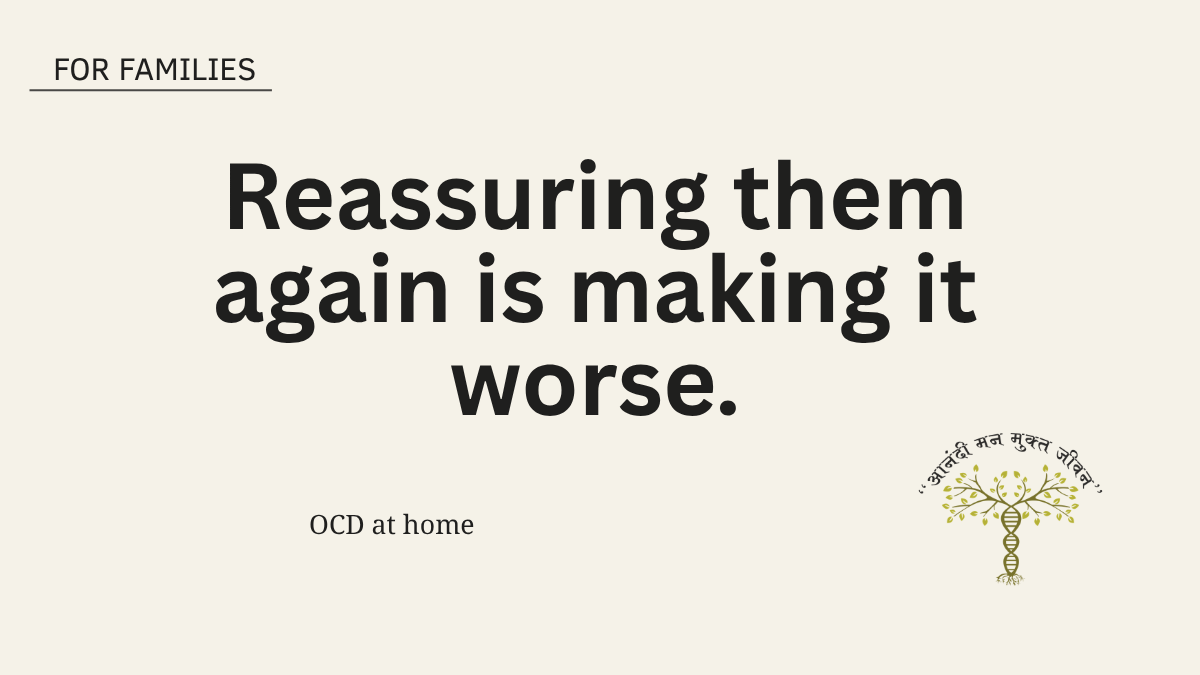
You answer “are you sure the gas is off?” for the fortieth time. You wash your hands the way she insists before touching the kitchen. You wait forty minutes in the car while his checking finishes. Each act feels like kindness. Each one, unfortunately, is feeding the OCD.
This is the hardest idea in this article, and the most important one. Let’s take it slowly.
The short answer
- OCD is an anxiety-driven brain condition— obsessions (unwanted thoughts) force compulsions (rituals) that relieve anxiety briefly and strengthen it long-term.
- Family “accommodation” — joining rituals, giving reassurance — feeds the same loop.Most families do it; it’s done from love; it still feeds the illness.
- Reducing accommodation is done gradually, warmly, and ideally with the doctor’s guidance — never as a sudden, harsh cut-off.
- Effective treatment exists— a specific therapy (ERP) and medicines — and family cooperation makes it work far better.
- The person is not their thoughts.OCD attacks precisely what a person values most.
Understand the loop first
An obsession is an intrusive, unwanted thought, image, or doubt — contamination, harm coming to family, things being “not right,” even blasphemous or shameful thoughts that horrify the person having them. The thought creates intense anxiety. A compulsion — washing, checking, counting, repeating, or asking for reassurance — briefly relieves that anxiety.
Briefly. Then the brain learns: “the ritual saved us,” and the next obsession arrives stronger. This loop is the entire illness. Everything a family does either interrupts the loop or reinforces it.
One essential kindness before anything else: people with OCD usually know their fears are excessive. They are not being stubborn or dramatic; they are trapped between a thought that terrifies them and a ritual that shames them. Mockery (“again washing?!”) lands on a person already exhausted by their own mind.
The hidden habit: family accommodation
Research on OCD consistently finds that in the great majority of affected households, family members participate in the illness without realising it. This is called accommodation, and it wears everyday clothes:
- Answering the same reassurance question repeatedly (“yes, it’s clean; yes, I’m sure; yes, really”)
- Performing rituals on the person’s behalf or by their rules (washing, arranging, checking)
- Restructuring family life around the OCD — guests not invited, outings timed around rituals, rooms nobody may enter
- Providing extra soap, sanitiser, time, silence — the illness’s supply chain
Why it matters: accommodation is relief in the moment and fuel over time. Higher family accommodation is consistently linked with more severe OCD and poorer treatment response. The illness effectively recruits the whole family into its loop.
How to withdraw accommodation — without cruelty
Never switch overnight from full cooperation to refusal; that produces panic, conflict, and sometimes worsening. The humane sequence:
- Name it together, outside a ritual moment.“The doctor explained that when I keep answering the checking questions, it makes the OCD stronger. I want to help you, not it.”
- Choose one accommodation at a time,ideally the easiest, ideally with the treating doctor or therapist choosing with you.
- Replace reassurance with warmth plus a boundary.Not silence, not scolding: “I love you, and we agreed I won’t answer that question — the anxiety will pass on its own. I’ll sit with you while it does.”
- Expect a temporary rise in distress.Anxiety that is not fed by a ritual rises, peaks, and falls — experiencing that fall is literally how recovery happens. Your calm presence through the peak is the real help.
- Acknowledge courage, not just success.Resisting a compulsion for five minutes is a genuine achievement worth naming.
Treatment works — and needs the family
The specific therapy for OCD is Exposure and Response Prevention (ERP) — gradually facing feared situations without performing the ritual, with professional guidance. Medicines (commonly SSRIs, often at particular doses the doctor will decide) reduce the obsessional pressure and make therapy more possible. Family members are often invited into treatment planning precisely because accommodation reduction is part of the protocol. Say yes to that invitation.
When to seek help urgently
Beyond routine consultation: seek prompt help if rituals consume hours daily or block eating, sleeping, or work; if skin is being damaged by washing; if the person speaks of self-harm or being a burden (contact the doctor or Tele-MANAS 14416 the same day); or if obsessions involve such distress that the person is afraid to be alone with their own thoughts. A note that reassures many families: disturbing intrusive thoughts — even violent or taboo ones — are a recognised symptom of OCD, not intentions. The horror the person feels about them is itself the signature of OCD.
A family's story
An illustrative composite, not a real patient.
A college student’s mother described their evenings: two hours of questions — “did you wash after the vegetables? touch my books after washing? are you sure?” — and a household that had quietly stopped inviting relatives. “I answer because if I don’t, she cries,” the mother said. “Am I supposed to let my daughter cry?” Treatment began — therapy and medicine for the daughter, and, just as importantly, structured guidance for the mother. They started with a single change: one answer per question, then warmth without repetition. The first week was tearful. By the second month, the question-hours had halved; by six months, relatives were visiting again. The mother’s summary belongs in a textbook: “I thought love meant answering every time. Love meant sitting with her while she didn’t need the answer.”
Frequently Asked Questions.
Is OCD just being very neat and particular?
No. Preferring order is a personality trait; OCD is anxiety-driven, time-consuming, and distressing. The casual use of “I’m so OCD” trivialises a serious condition.
Did we cause it by strict upbringing?
No. OCD arises from brain circuitry and vulnerability, not parenting style. Families influence its course (see accommodation), not its cause.
If we stop helping with rituals, aren't we being cruel?
Sudden refusal is harmful; gradual, warm, guided reduction is treatment. The cruelty would be feeding the illness for another decade.
Can OCD be cured?
OCD responds well to proper treatment — many people achieve major, lasting improvement and full functioning. Honest framing: managed and minimised, sometimes to the point of near-silence; vulnerable to return under stress; re-treatable if it does.
Sources
- Indian Psychiatric Society — Clinical Practice Guidelines for OCD
- International OCD Foundation — family accommodation resources
- World Health Organization — ICD-11, obsessive-compulsive disorder
- Government of India — Tele-MANAS (14416)