
Caring for a Family Member with Schizophrenia: A Psychiatrist's Guide
Caring for a Family Member with Schizophrenia: A Psychiatrist's Guide
Few diagnoses frighten Indian families like schizophrenia. The word arrives carrying decades of film imagery, neighbourhood whispers, and the terrible question: what will happen to them after us?
Here is what the fear hides: schizophrenia is a treatable brain condition, most people improve substantially with sustained treatment, and the family’s daily behaviour is one of the strongest influences on how recovery goes. That last part is this article.
The short answer
- Schizophrenia is a brain illness— not possession, not weak character, not bad parenting.
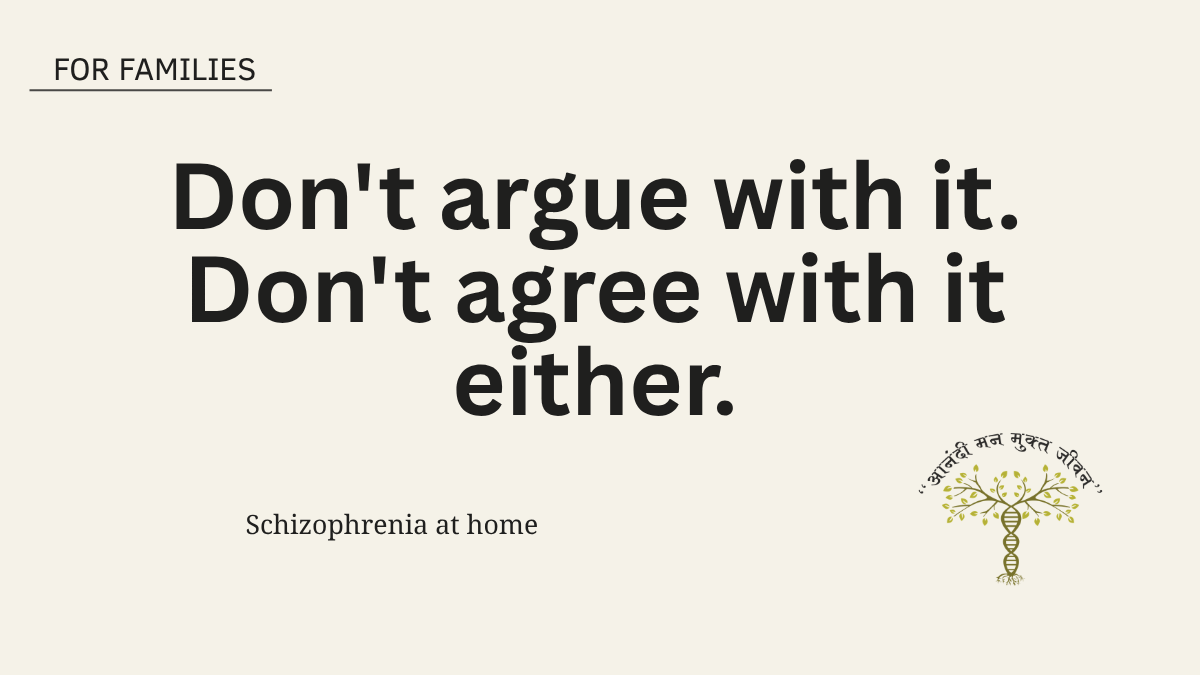
- Don’t argue with delusions; don’t endorse them either.Respond to the feeling, not the content.
- A calm, low-criticism home is treatment.This is one of the most replicated findings in psychiatry.
- “Laziness” is usually a symptom.Negative symptoms are part of the illness.
- Continuous medicine + early relapse responseis what long-term stability is built from.
What schizophrenia is — and is not
Schizophrenia affects how the brain processes reality. During acute phases, there may be hallucinations (most often hearing voices), delusions (fixed false beliefs — being watched, plotted against), and disorganised thinking. Just as important are negative symptoms: loss of motivation, flat emotional expression, social withdrawal, neglect of self-care.
It is not “split personality,” it is not caused by black magic or anyone’s sins, and — a guilt every mother in the consulting room carries — it is not caused by upbringing.
How to respond to delusions and voices
The instinct is to argue: “No one is poisoning your food, see, I’ll eat it!” Arguing fails, because a delusion is not a mistaken opinion — it’s a symptom, held with the same certainty you hold your own name. But agreeing (“yes, the neighbours are dangerous”) feeds it.
The middle path: acknowledge the emotion, stay neutral on the content, stay on their side. – Instead of “that’s nonsense” → “That sounds frightening. I’m here, and you’re safe right now.” – Instead of debating → “I don’t experience it that way, but I believe it feels completely real to you.”
You are not trying to win the argument. You are trying to remain the person they trust — because that trust is what gets them to appointments.
Sleep is not a lifestyle detail here
Reduced sleep is both an early signal of mania and a trigger for it. Protecting regular sleep — consistent timings, calm nights, flagging sleep loss to the doctor early — is one of the most evidence-supported things a household can contribute. Late-night family functions, overnight travel, and festival seasons deserve gentle planning, not avoidance.
The home atmosphere is part of the treatment
Decades of research on families and schizophrenia converge on one finding: relapse is significantly more frequent when the home environment is high in criticism, hostility, or anxious over-involvement — and significantly less frequent in calm, warm, low-conflict homes. This is not about blame; families criticise because they’re exhausted and frightened. It’s about leverage: lowering the temperature at home is one of the few treatment factors entirely in the family’s hands.
Practically: fewer taunts and comparisons (“look at your cousin”), fewer emotionally charged confrontations, more short, warm, low-pressure interactions. Not walking on eggshells — just choosing calm consistently.
"He's become so lazy" — the most misread symptom
When a person sits all day, skips bathing, and shows no interest in anything, families see character failure. Psychiatry sees negative symptoms — as much a part of schizophrenia as the voices, and often slower to improve. Respond as you would to weakness after typhoid: gentle structure, small tasks with company (“help me cut vegetables”), patience measured in months. Scolding does not treat a symptom; it only adds the criticism that worsens outcomes.
Medicines, relapse, and the long arc
Antipsychotic medicines are the foundation; stopping them is the most common road to relapse, and each relapse can make recovery harder. If tablets keep being “forgotten” or refused, tell the doctor rather than beginning daily battles — options exist, including long-acting injections given every few weeks, which many families find transforms the struggle.
Learn your loved one’s early relapse signs — commonly: worsening sleep, returning suspiciousness, muttering to themselves, withdrawal deepening — and agree in advance that any of these means an early appointment, not a wait-and-watch.
Rights, papers, and the future
Two practical anchors every family should know. The Mental Healthcare Act 2017 guarantees your loved one’s right to dignified treatment, confidentiality, and community living. And under the Rights of Persons with Disabilities Act 2016, chronic mental illness is a recognised disability — meaning that where illness causes lasting functional limitation, disability certification can open concessions and, for the question that keeps parents awake, legal structures for long-term care planning exist. Ask your treating psychiatrist to guide the paperwork; this deserves a full article of its own.
The question of "what will people say"
Stigma isolates families precisely when they need support. You do not owe the whole neighbourhood an explanation — but total secrecy usually costs more than selective honesty. Most families find a middle path: a small circle who know and help, and a simple sentence for everyone else (“he’s under treatment for a health condition and improving”).
A family's story
An illustrative composite, not a real patient.
A retired teacher and his wife had spent three years in a loop with their son: he would improve, stop medicines, relapse, and each relapse was louder than the last. The household had become a courtroom — every meal a hearing on whether he’d taken his tablet. Two changes broke the loop. His treatment shifted to a monthly injection, ending the daily battle. And his parents, counselled about the home atmosphere, replaced interrogation with one warm shared activity a day — evening tea on the terrace, no agenda. Improvement was not cinematic; it was cumulative. Eighteen months later he was helping run the family stationery shop in the mornings. His father’s summary: “We stopped fighting the illness in front of him, and started fighting it beside him.”
Frequently Asked Questions.
Will they ever be completely normal again?
Recovery is real and common, and usually gradual and partial-to-substantial rather than overnight. Many people return to work, relationships, and independent routines. Honest doctors promise direction, not dates.
Is it safe to live with them? Aren't they violent?
The film stereotype is wrong: people with schizophrenia are far more often withdrawn than aggressive, and are more likely to be victims than perpetrators of harm. Where agitation does occur, it’s usually in untreated illness — one more reason treatment continuity matters.
Should we get them married "to settle them"?
Marriage is not a treatment, and concealing the illness from a prospective spouse is both unethical and a recipe for crisis. Stabilise first; then, if they wish to marry, with honesty.
They refuse to see any doctor. What can we do?
Consult the psychiatrist yourselves first — families can be guided even before the patient comes, and the Mental Healthcare Act provides lawful, humane pathways for treatment when illness removes insight. Never resort to unlicensed “centres” that promise to take the person away; they are dangerous and illegal.
Sources
- Indian Psychiatric Society — Clinical Practice Guidelines for Schizophrenia
- World Health Organization — schizophrenia fact sheet
- Mental Healthcare Act, 2017 & Rights of Persons with Disabilities Act, 2016 (Government of India)
- Government of India — Tele-MANAS (14416)